Compose
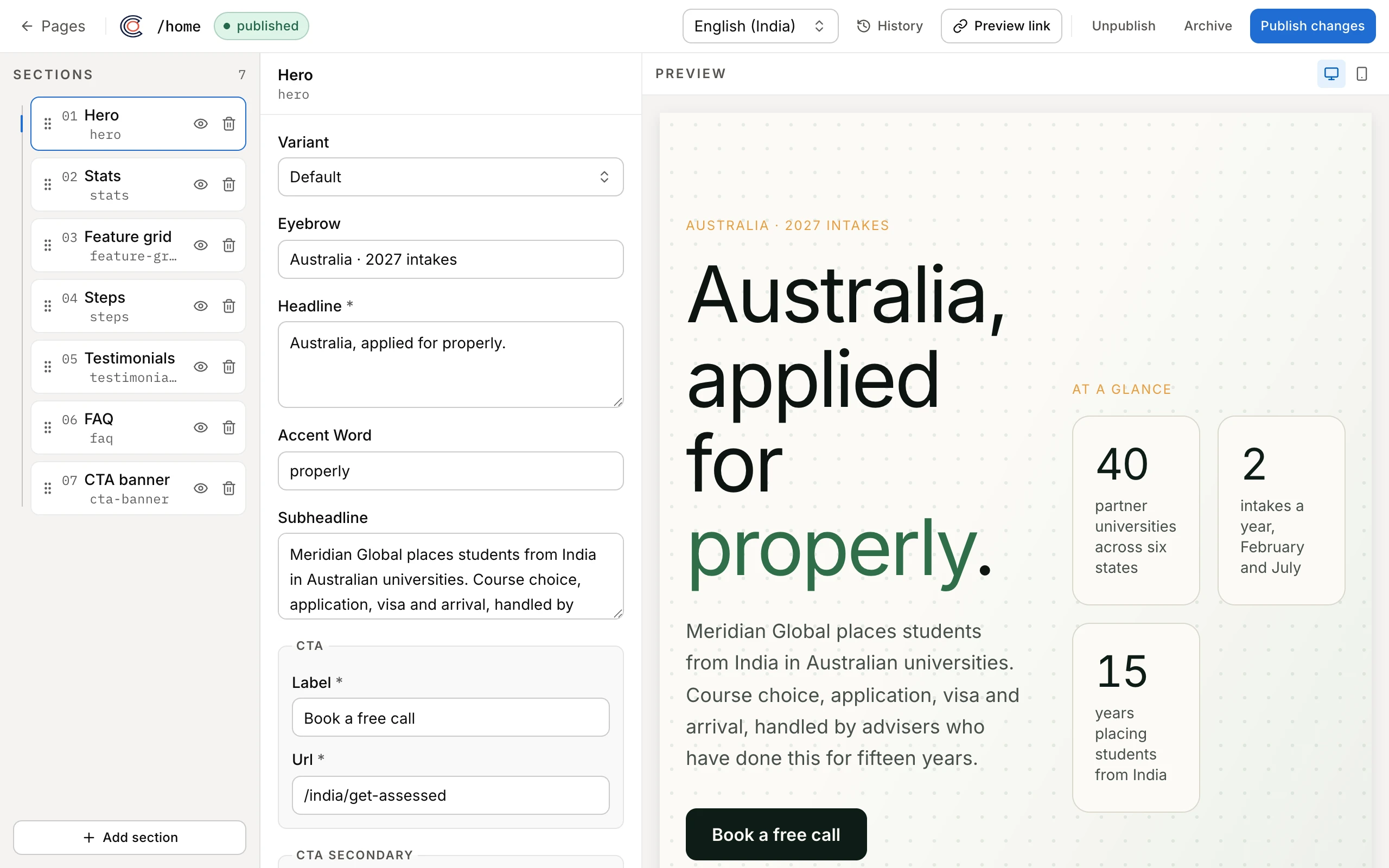
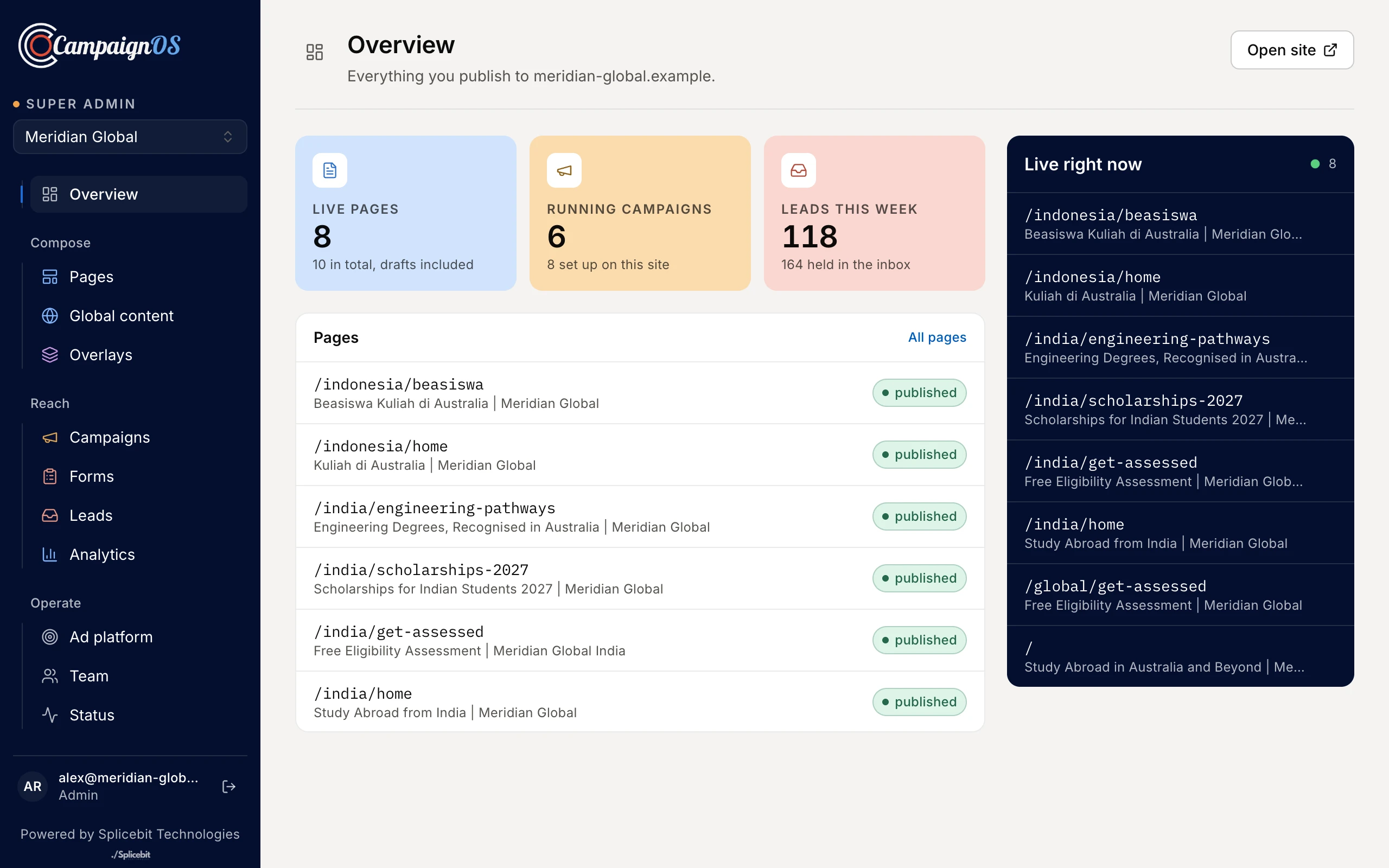
Build the page from ready-made blocks designed around your brand. Each block asks only for the words and pictures it needs, so nobody has to think about layout and nothing can come out looking wrong.
Your team builds landing pages from a kit designed around your brand, puts them live in minutes and keeps every enquiry in one place you control.
The tour
Build the page from ready-made blocks designed around your brand. Each block asks only for the words and pictures it needs, so nobody has to think about layout and nothing can come out looking wrong.
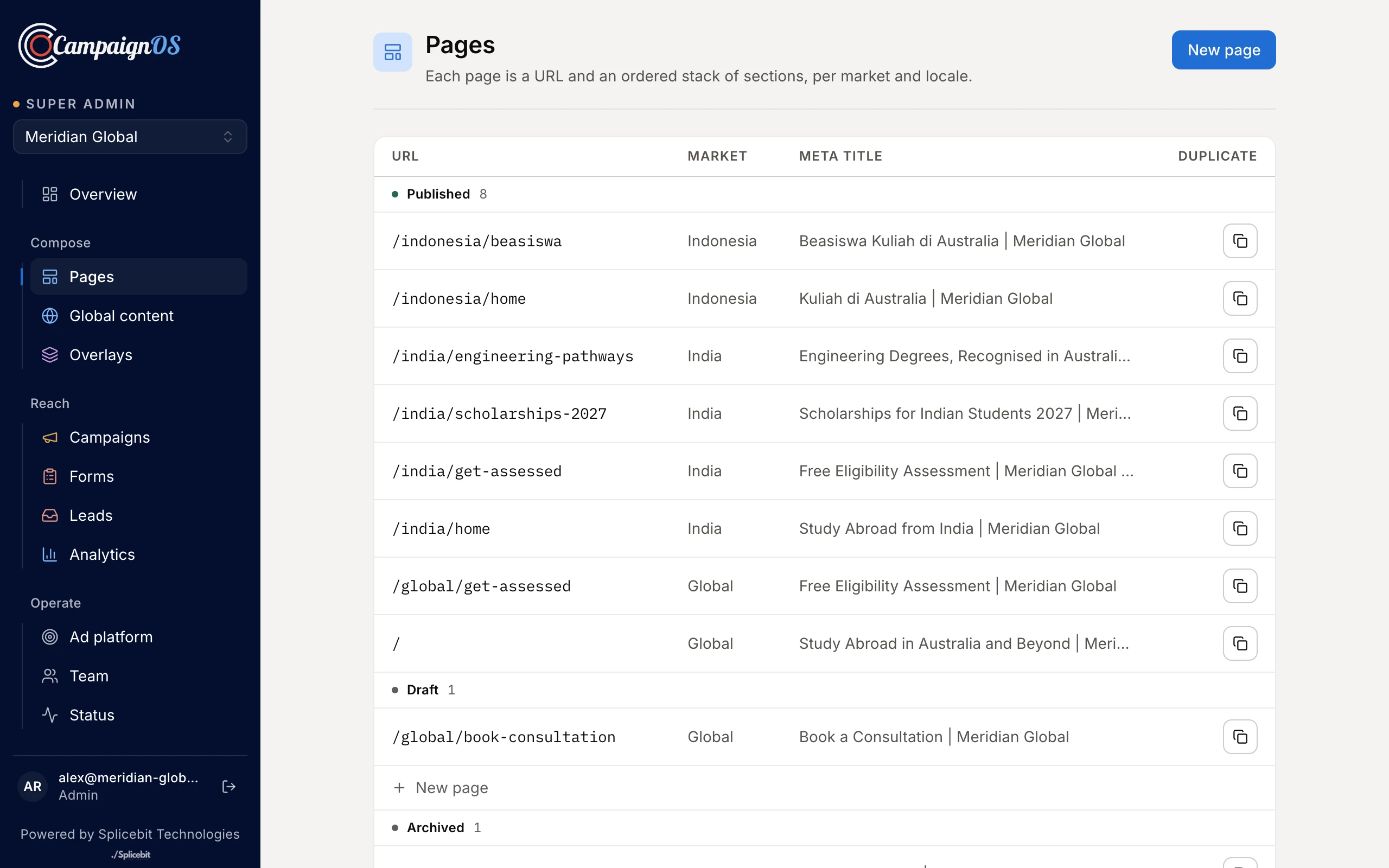
Share a preview link, then put the page live when everyone is happy. The web address is worked out for you, and the housekeeping that gets a page found on Google is handled in the background rather than left on somebody's checklist.
Every enquiry lands in one place, already labelled with the campaign it came from, the ad or search that sent it and the page the person was reading. It is your data, and you can export it whenever you want.
See which pages and which campaigns are actually bringing enquiries in, so you can put money behind what works. Results go back to your ad platforms from our own servers, which keeps your reporting accurate even when a browser blocks the usual tracking.
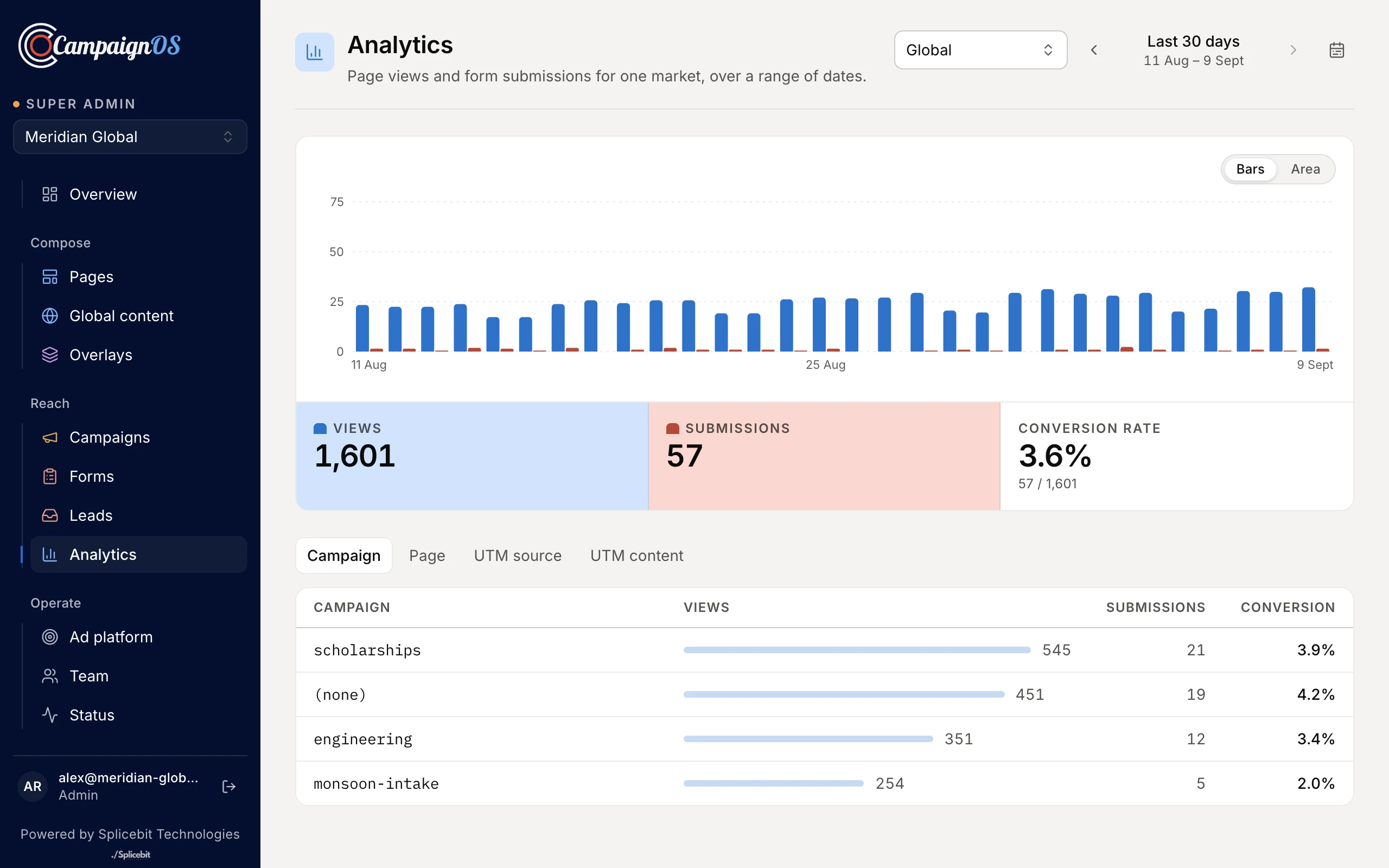
Meridian Global is a study abroad consultancy running paid campaigns in India for the 2027 intake. It has one landing page, and each advert points at that same page with a tag on the end.
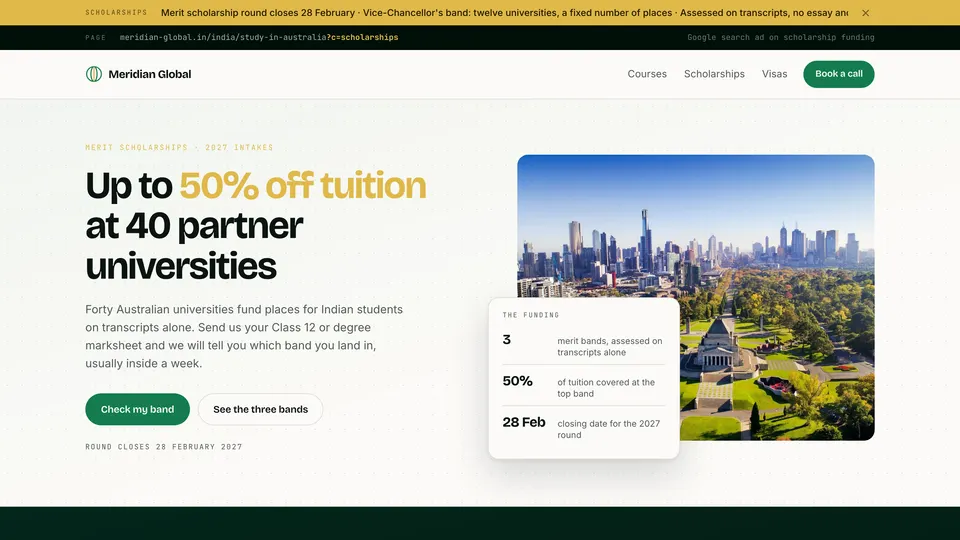
Scholarships
?c=scholarships
From a Google search ad on scholarship funding
‘Up to 50% off tuition at 40 partner universities’
The course blocks become scholarship eligibility, and a popup arrives after twenty seconds.
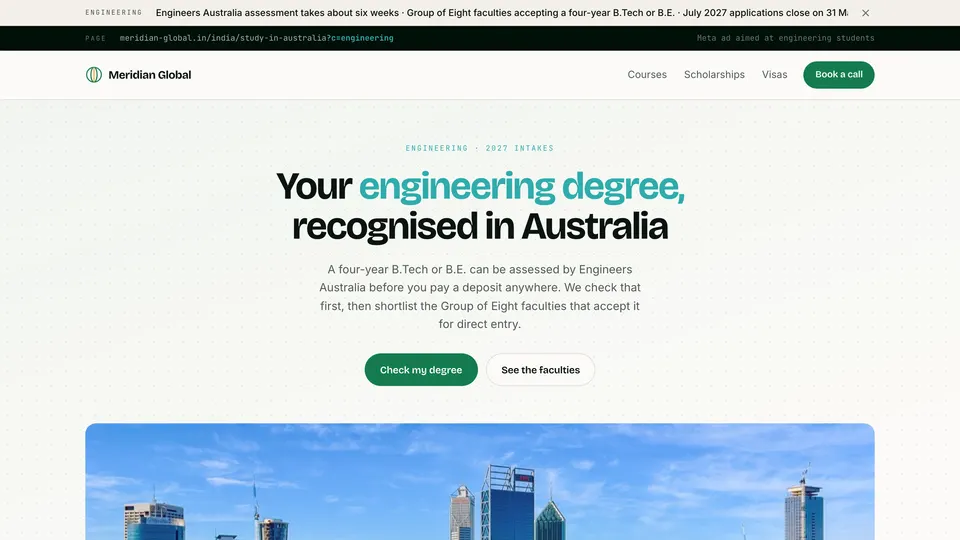
Engineering
?c=engineering
From a Meta ad aimed at engineering students
‘Your engineering degree, recognised in Australia’
The course blocks become Group of Eight engineering faculties, and the testimonials become engineering graduates.
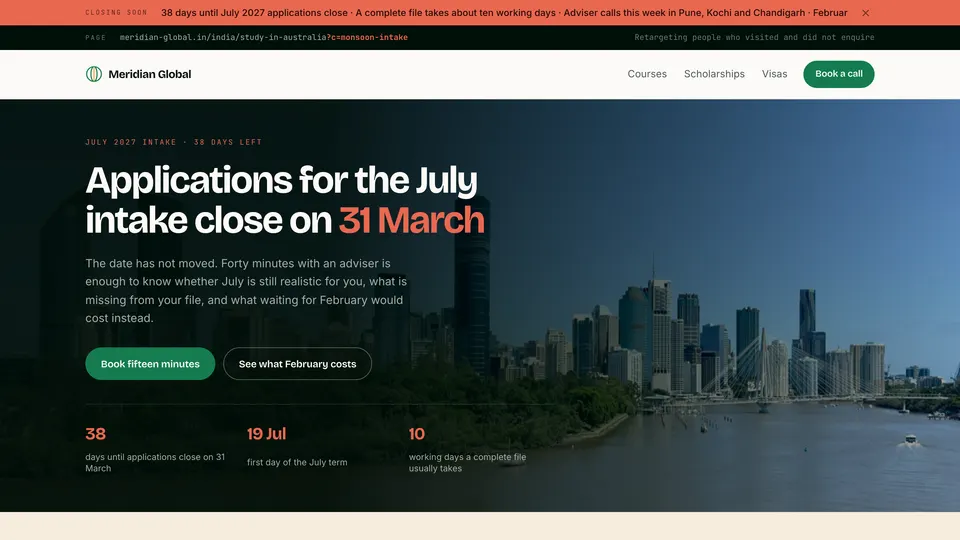
Monsoon intake
?c=monsoon-intake
Retargeting people who visited and did not enquire
‘Applications for the July intake close on 31 March’
The hero carries the deadline, and a sticky bar keeps it on screen as they scroll.
A worked example. Meridian Global is not a real company, and the bar above each page is part of the mock: it names the campaign and where the click came from.
Same page. Same structure. Same web address. A campaign changes what a block says, never which blocks exist, which is why none of the three can come out looking wrong.
One page exists, not three.
Three campaigns sit over it, each holding only the blocks it changes.
No developer, no release, no new web address.
It is content, so putting it live costs nothing and breaks nothing.
Google sees one page.
Only the page itself is indexed. The three campaign addresses are hidden from search and point back to it, so there is no duplicate content and no split ranking.
Every enquiry arrives labelled.
You know which of the three produced it before anyone picks up the phone.
Ending a campaign is one click.
It leaves nothing behind, because there was never a second page to take down.
The same pattern is how a clinic, a property developer or a software company would run it. Only the words change.
What it does
Every block asks only for the content it needs. There is no free-form editor and no styling controls to get wrong, so a page put together at 5pm on a Friday still looks like the rest of your site. Pick a block to see exactly what it asks for.
What the hero block asks an author for. This is the whole list, with nothing hidden behind it.
Enquiries come straight to you and export whenever you ask. No third party form service sits between you and the people getting in touch.
every market
Each country and language gets its own pages and its own web addresses, set up for you. Opening a new market does not mean building a new site.
one page
The same page can say something different to visitors from a particular ad or country. Nobody has to make a second copy of it and keep the two in step.
no popup wars
Banners and popups pick from four triggers, never free text, and each is capped so nobody meets it twice in a session. One per position, so nothing stacks.
nothing lost
Ad blockers stop some results reaching your ad platform, so it optimises on a partial picture and you pay more. We send ours from our servers, contact details made unreadable.
6 more things it does
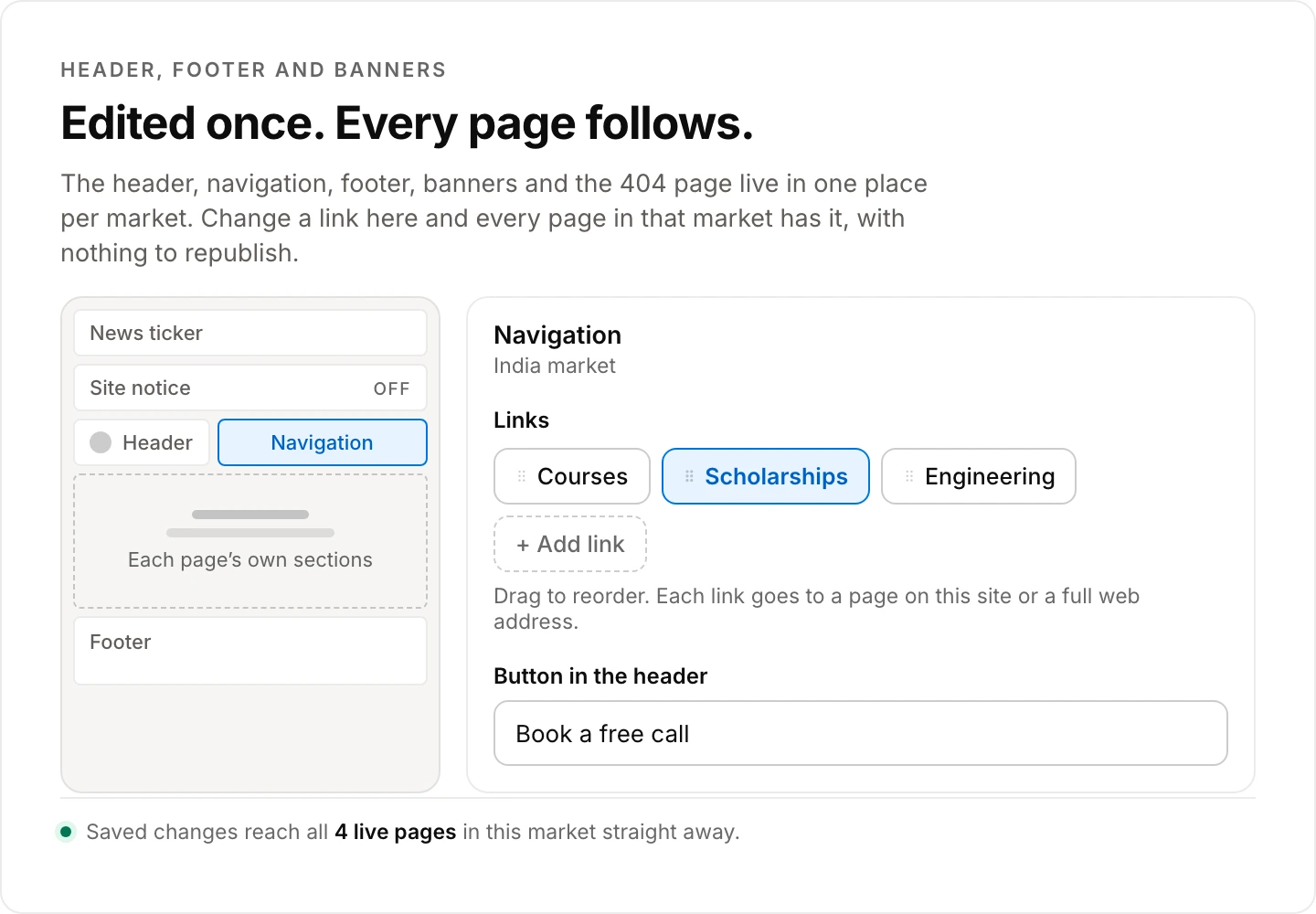
Menus, headers and footers are edited once, and every page that uses them updates with them.
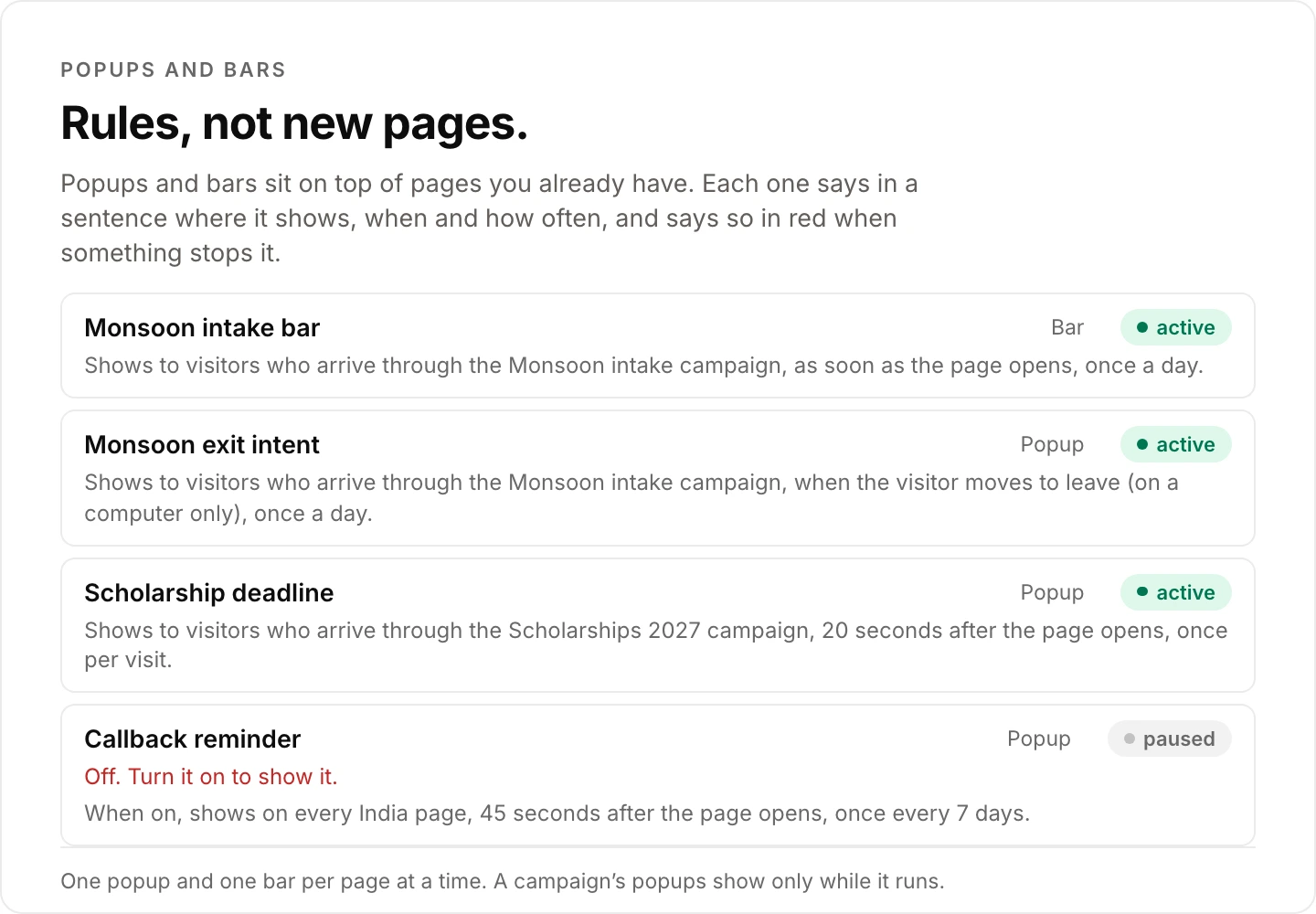
Popups and bars follow their own rules about where, when and how often they appear.
Choose what you ask each visitor for, and decide where every enquiry should be sent.
Connect your advertising accounts once per country, and keep each market's reporting apart.
Invite the people who need access, and give each of them only what their job requires.
See at a glance that every site is up and that each enquiry reached where it should.
Signpostby CampaignOS
Today that link opens somebody else's page, under somebody else's logo, and every enquiry it sends you lands in your reports as 'direct'. Signpost is that page rebuilt on your own domain, in your own brand, and wired to the same lead record as every page you publish.
yourbrand.com/go/ig in the bio, your name in the link preview and no other company's logo at the foot of the page.
Source, medium, campaign and content are written to the enquiry, so a lead from your bio shows up in reporting as Instagram.
Show a link only to visitors in one country. The India scholarship reaches India, and everyone else sees the rest.
Every look is mixed from your brand theme, and a combination that would be hard to read is switched off before anyone can publish it.
Try it. Every control here is one your team gets in the composer. Tap a link in the phone and watch the mascot follow it.
Meridian Global
Study abroad advisers for Australia, the UK and Canada
Brand theme
set once, at onboarding
Appearance
What the marketing team chooses, in the composer.
Layout
the section variant
Backdrop
mixed from the brand colours
Buttons
shape comes from the brand's corner radius
Motion
ignored when a visitor asks for less of it
Mascot
your own, or one from the library
Where it sits
never over a link
Sponsor
one slot, always labelled
Sample data. Meridian Global and its four sponsors are fictional businesses and meridian-global.example is not a real address. The seventh backdrop, a photograph you upload, is left out because it needs a photograph.
Sponsor slotPaid add-on
Before they fly, your audience needs a loan, a room, a forex card and health cover. Offer one of those businesses the card at the foot of your signpost, at a price you agree with them. Pick a sponsor in the phone above to see where it sits.
A Sponsored label nobody can remove or reword, and a sponsored link tag for search engines.
The sponsor sends a logo, a title and a link. The card takes your colours and your current look.
No scripts, pixels or embeds, so a sponsor never adds a tracker or a cookie banner to your page.
Views, taps and tap rate for the sponsor, by day, downloaded as a spreadsheet you can send them.
Limit the card to visitors in one country, like any link on the page.
Put the sponsor in a campaign and it comes down on the campaign's end date, without anyone having to remember.
A link-in-bio tool rents you a page. Signpost gives you one: your domain, your brand, and every tap on the lead record before anybody picks up the phone.
None of this is impossible to assemble. It is what most teams end up doing, one purchase at a time, and the bio link is the one they forget is a purchase at all.
Normally you buy
With CampaignOS
One supplier. One renewal date. One party accountable.
What the assembly costs
The eight subscriptions above
₹31,800 · $336 a month
A developer, on retainer
₹25,000 to ₹50,000 · $265 to $529 a month
Every new campaign page
₹40,000 to ₹1,50,000 · $423 to $1,587 one off
List prices, annual billing, at ₹94.5 to the dollar, September 2026. Every campaign is another build, so six a year is six builds.
Ten suppliers. Ten renewal dates. Nobody accountable when one of them breaks.
Two payments, and what each one buys. The figures come with the scope, once we have looked at the pages you already have.
Once, to get you live
Every month, flat
Optional add-onA sponsor slot on your signpost
One disclosed sponsor card, with a report you can hand over. Switched on per client, priced with the scope.
Everything above this is live and running today. Nothing here is needed for any of it. These are the things being built next, and we do not put dates on them until they are ready.
Write to the people who already enquired, from the same place their enquiry landed, rather than exporting a list into another tool. Today an enquiry is captured, labelled and handed on. Nothing here writes the follow-up yet.
Your Meta ad spend read back into the console and matched to the enquiries it produced, so you see what each one cost, not only how many arrived. Sending results out to Meta already works. This is the other direction.
Take application fees, deposits and recurring payments on the page itself, so someone can pay at the moment they decide instead of waiting for an invoice to reach them. Today a page can take the enquiry but not the money.
A reply on WhatsApp within seconds of someone getting in touch, on the channel your markets actually use. Today an enquiry reaches an inbox or your own system, and a person still has to notice it and pick it up.
Let someone choose a time on the page instead of leaving a number and waiting for a call. A form only tells you who is interested. A booking tells you when you will be speaking to them.
Answer a visitor's questions on the page itself, in the tenant's own voice, so they get a reply before deciding whether to fill in the form. Today the only way to ask is to submit an enquiry and wait.
Describe the offer and get a first draft of the page, with sections and copy already in place, instead of starting from a blank composer. Today every page is built by hand, one section at a time.
A check in the composer that flags missing alt text, thin content and broken links before you publish, plus a site-wide report on indexing, crawl errors and orphaned pages. Canonical URLs, hreflang and sitemaps already work.
One place for your pages, your campaigns and the people who get in touch.
